If you are applying for a competitive role, your resume needs to do more than list experience. It has to prove, quickly and clearly, that you are the right fit.
Resume optimization is the process of improving your resume so it matches what recruiters, hiring managers, and applicant tracking systems are looking for. In competitive hiring markets, that difference can decide whether your application gets noticed or ignored.
What Resume Optimization Means
Resume optimization is not about stuffing keywords into a document. It is about making your experience easier to understand, more relevant to the job, and more persuasive to the reader.
A well-optimized resume highlights the strongest parts of your background, uses the right language for the role, and removes anything that weakens your message. For competitive positions, that means every line should earn its place.
Why It Matters for Competitive Roles
When a role attracts many qualified applicants, hiring teams often skim resumes very quickly. They may spend only a few seconds deciding whether to keep reading.
That means your resume must create immediate clarity. If your most relevant achievements are buried, your formatting is messy, or your wording is too generic, you can lose attention fast. Resume optimization helps you stand out in that crowded first review.
Start With the Job Description
The best place to begin is the job description itself. Read it carefully and look for repeated skills, tools, responsibilities, and language patterns.
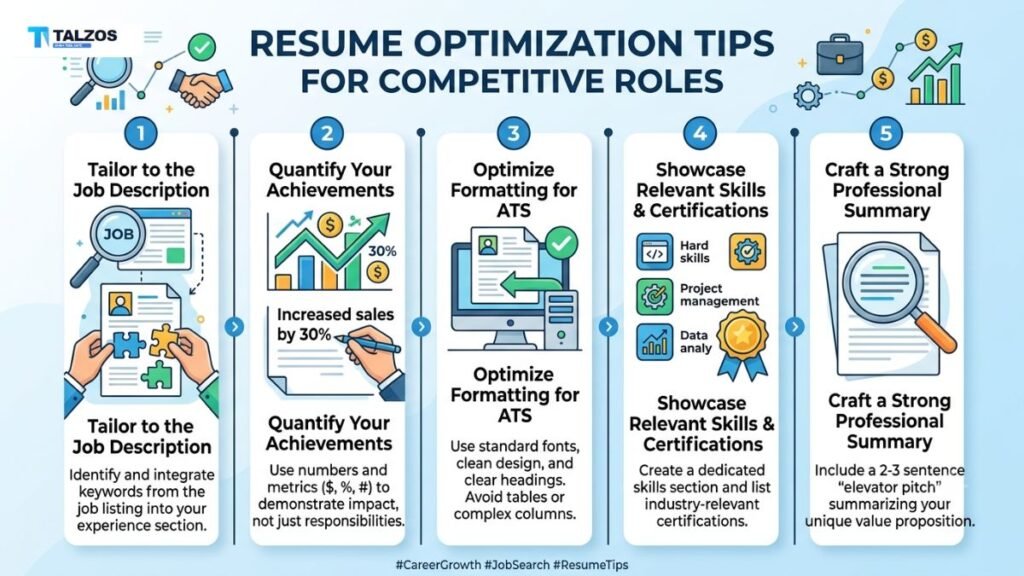
You do not need to copy the posting word for word. Instead, identify the main themes and reflect them naturally in your resume. If a job asks for stakeholder management, cross-functional collaboration, and data-driven decision-making, those ideas should appear clearly in your experience if they apply to you.
Match Your Resume to the Role
A strong resume should not be the same for every application. Competitive roles usually demand targeted resumes that reflect the exact position.
Focus on the experience, results, and skills most relevant to that job. If you have a long background, prioritize the parts that support the role you want now. This is one of the most effective resume optimization strategies because it helps recruiters see fit faster.
Use a Clean Structure
A cluttered resume makes it harder to find your value. A simple and clear layout improves readability for both humans and applicant tracking systems.
Use standard sections such as:
- Summary.
- Skills.
- Work experience.
- Education.
- Certifications, if relevant.
Keep formatting consistent, use readable fonts, and avoid overdesigned templates that may confuse scanning systems. For competitive roles, clarity usually performs better than creativity.
Write a Strong Summary
Your summary sits at the top of the page, so it should quickly explain who you are and what value you bring. Think of it as a short professional snapshot.
A good summary includes your role level, industry focus, key strengths, and a brief value statement. For example, instead of saying “results-oriented professional,” you could say, “Marketing specialist with 6 years of experience growing B2B demand through content strategy, campaign analysis, and cross-functional execution.”
Focus on Achievements, Not Duties
One of the biggest resume mistakes is listing tasks instead of results. Hiring managers already know what the job involved; they want to know what you accomplished.
Turn ordinary responsibility statements into achievement-based bullets. For example:
- Instead of: Managed social media accounts.
- Write: Grew social media engagement by 48% in six months through a revised content and posting strategy.
Numbers, percentages, timelines, and outcomes make your resume more credible and memorable. They also strengthen resume optimization because they help your experience feel specific and measurable.
Use Keywords Naturally
Keywords matter because many employers use software to screen resumes before a human sees them. But keyword use should still feel natural.
Include role-relevant terms from the job description in your summary, skills section, and experience bullets where appropriate. For example, if the role requires project management, include specific tools, methodologies, and outcomes that prove that skill. Avoid cramming in too many keywords, which can make your resume sound forced and repetitive.
Make Every Bullet Count
Each bullet should do one of three things: show impact, demonstrate skill, or prove relevance. If a bullet does none of those, it may be taking up space without helping you.
Use action verbs like led, improved, launched, streamlined, negotiated, or designed. Keep bullets concise, but not vague. A strong bullet tells a story in one or two lines and gives the recruiter a reason to keep reading.
Tailor Your Skills Section
Your skills section should support the role, not simply list everything you know. Competitive applications benefit from focused skill alignment.
Group skills into useful categories if needed, such as technical skills, tools, and leadership skills. This makes scanning easier and shows that your strengths are organized. Only include skills you can genuinely discuss in an interview.
Remove Weak or Irrelevant Content
A crowded resume can hide your best qualifications. If a detail does not help you for the role you want, cut it or reduce it.
This may include outdated software, unrelated early-career tasks, old certifications, or hobbies that do not add value. Resume optimization often improves when you remove more than you add.
Improve Readability
A resume should be easy to scan on a laptop, tablet, or phone. Clear formatting helps the reader absorb your value without effort.
Use short sections, balanced spacing, and consistent bullet structure. Keep sentence length manageable and avoid long paragraphs. If a recruiter has to work hard to understand your resume, your message is already weaker.
Show Career Progression
If you are applying for a competitive role, your resume should show growth. Employers like to see increasing responsibility, stronger results, or broader scope over time.
If you were promoted, took on leadership, or managed larger projects, make that obvious. A strong career narrative can be just as persuasive as a single standout achievement.
Address Employment Gaps Carefully
If you have gaps in your work history, do not panic. You do not need to overshare, but you should make your timeline easy to follow.
Use clear dates, include relevant freelance work, consulting, certifications, volunteering, or education if it strengthens your profile. The goal is to present a confident and complete picture without drawing unnecessary attention to time away from full-time work.
Customize for Senior and Entry Roles
Resume optimization looks different depending on experience level. Entry-level candidates should emphasize education, internships, projects, and transferable skills. Senior candidates should focus on leadership, strategy, business impact, and scale.
For competitive senior roles, recruiters want proof that you have solved complex problems and influenced outcomes. For junior roles, they want evidence that you can learn quickly and contribute reliably. Your resume should reflect that distinction.
Use Metrics Whenever Possible
Metrics make your resume more convincing. They turn vague claims into concrete evidence.
Examples include revenue growth, cost savings, time reduced, conversion rates, team size, customer satisfaction, project volume, or process improvements. Even simple metrics can strengthen your message. If you improved something, quantify it.
Avoid Common Resume Mistakes
Many candidates lose points because of avoidable errors. Common issues include:
- Using the same resume for every job.
- Writing vague summaries.
- Listing duties without results.
- Including too much text.
- Using fancy formatting that hurts readability.
- Leaving grammar or spelling mistakes.
- Overloading the resume with keywords.
A polished resume should feel intentional, not rushed. Small mistakes can make a competitive candidate look less prepared than they really are.
Humanize the Content
Even though resume writing is strategic, it should still sound like a real person wrote it. Hiring teams connect with candidates who sound clear, confident, and grounded.
Use direct language. Focus on real contributions. Avoid buzzwords that sound empty or robotic. The best resume optimization keeps the document professional while still letting your personality and judgment come through.
Final Resume Optimization Checklist
Before you send your resume, check the following:
- It matches the job description closely.
- The summary reflects the role you want.
- Bullets focus on outcomes, not just tasks.
- Keywords appear naturally.
- Formatting is clean and consistent.
- The most relevant experience appears near the top.
- There are no grammar or spelling errors.
If you can answer yes to most of these, your resume is in strong shape for a competitive application.
Conclusion
Resume optimization is one of the most practical ways to improve your chances in a crowded job market. When your resume is targeted, readable, and achievement-focused, it becomes much easier for employers to see your value.
For competitive roles, the goal is not to say more. It is to say the right things, in the right way, at the right time. If you want, I can also turn this into a more conversational blog post, add FAQs, or format it for WordPress SEO.