LinkedIn is no longer just a place to list your job title, share company updates, or congratulate colleagues. It has become a busy content platform where professionals exchange ideas, build trust, attract opportunities, and grow personal brands.
However, publishing regularly does not automatically lead to better engagement. If your posts are difficult to read, poorly organized, or missing a clear message, people will likely scroll past them. The solution is to create content that feels easy to understand and worth responding to.
A strong LinkedIn engagement structure helps you organize your ideas in a way that catches attention, encourages readers to continue, and inspires them to take action. In this guide, you will learn how to improve your LinkedIn content’s readability, create more engaging posts, and build a structure that connects with real people.
Why LinkedIn Readability Matters
Readability refers to how easily someone can understand and move through your content. On LinkedIn, this matters because most users do not read every post carefully. They scan their feeds quickly, often on mobile devices, while looking for useful, interesting, or relatable information.
A large block of text can feel overwhelming. Long sentences may slow readers down. Complicated words can make a simple idea appear less approachable. Even valuable advice may receive little attention if readers cannot understand the main point within a few seconds.
Improving readability makes your message more accessible. It allows readers to identify your key idea, follow your argument, and remember what you shared. It also creates a more professional and thoughtful impression.
Good readability does not mean making every post basic or removing your personality. It means presenting your ideas clearly so that your expertise does not get buried under unnecessary words.
Build a Clear LinkedIn Engagement Structure
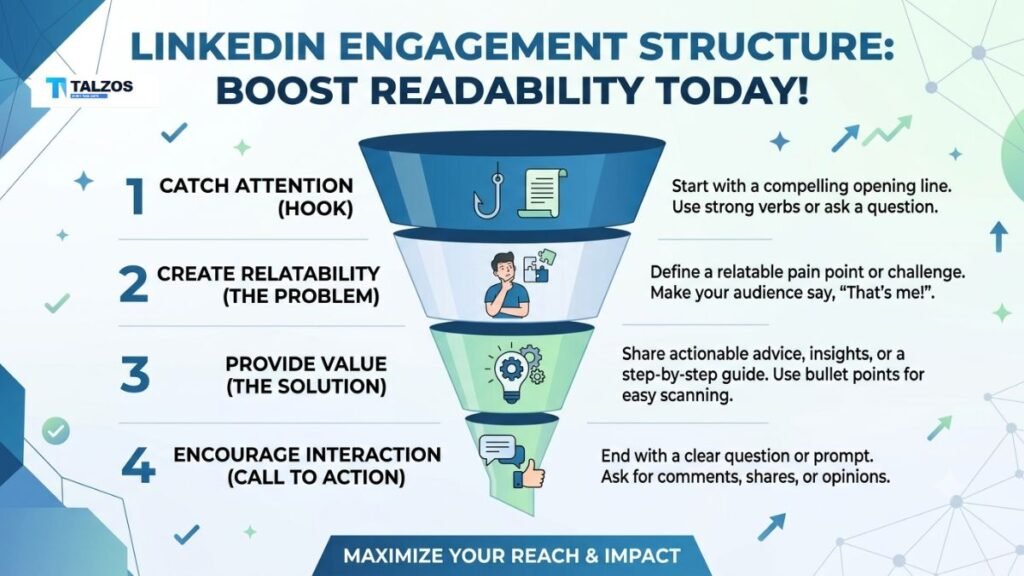
An effective LinkedIn post usually follows a simple path:
- Capture attention.
- Create interest.
- Deliver value.
- Encourage interaction.
This sequence forms the foundation of a practical LinkedIn engagement structure. It gives your post direction and helps readers understand why they should continue reading.
For example, imagine you want to write about workplace productivity. You could begin with a strong observation:
“Most productivity advice fails because it focuses on doing more instead of deciding what matters.”
This opening creates curiosity. You can then explain the problem, share three practical lessons, and finish with a question such as:
“What productivity habit has made the biggest difference in your work?”
The structure feels natural because it moves from attention to value and then to conversation.
Start With a Strong Hook
The first one or two lines of your LinkedIn post are extremely important. They determine whether someone pauses to read or continues scrolling.
A strong hook should be clear, specific, and relevant to your audience. It does not need to be dramatic or controversial. It simply needs to create enough curiosity for readers to want the next sentence.
Here are several effective hook styles:
Ask a relevant question
Questions invite readers to think about their own experiences.
“Why do some talented professionals struggle to communicate their value online?”
Share a surprising insight
An unexpected statement can make people curious.
“Being busy is not always a sign of progress. Sometimes it is a sign that your priorities are unclear.”
Highlight a common mistake
Readers often engage with content that identifies a problem they recognize.
“Many LinkedIn posts lose readers before the main idea even begins.”
Tell a short personal story
Personal experiences make professional content feel more human.
“When I first started posting on LinkedIn, I tried to sound like an expert. That approach made my writing stiff and difficult to connect with.”
Avoid vague openings such as “Here are some thoughts” or “I am excited to share.” These introductions rarely provide a reason to keep reading.
Make Your Posts Easy to Scan
LinkedIn users often scan content before deciding whether to read it completely. Your formatting should support this behavior.
Use short paragraphs, with one to three sentences in each section. White space creates visual breathing room and prevents your post from looking crowded. It also helps readers find the most important points quickly.
You can improve scanability by using:
- Short sentences.
- Simple vocabulary.
- One idea per paragraph.
- Numbered points for processes.
- Bullet points for related details.
- Occasional line breaks for emphasis.
- Clear transitions between ideas.
Avoid placing too many ideas into a single paragraph. If a paragraph discusses content strategy, audience research, and personal branding at the same time, readers may lose track of the main point.
A useful rule is to write for the eye as well as the mind. Your post should look inviting before anyone reads the first sentence.
Use Plain and Conversational Language
Professional writing does not need to sound formal, distant, or complicated. In fact, overly polished language can make your content feel less genuine.
Instead of writing:
“Organizations should prioritize the implementation of effective communication methodologies to facilitate improved collaboration.”
Write:
“Teams work better when communication is simple, clear, and consistent.”
The second version is easier to understand and sounds more natural. It also communicates the same idea with fewer words.
Use active voice whenever possible. For example:
- Passive: “The report was completed by the marketing team.”
- Active: “The marketing team completed the report.”
Active voice gives your writing more energy and makes your meaning clearer. It also creates a stronger connection between the reader and the person sharing the message.
Focus on One Main Idea
Many LinkedIn posts fail because they try to cover too much. A single post about leadership, productivity, networking, hiring, and personal development may contain useful information, but the message can feel scattered.
Before writing, ask yourself:
- What is the one idea I want readers to remember?
- Who needs this information?
- What problem does it solve?
- What should readers think, feel, or do after reading?
A focused post is easier to write and easier to engage with. It gives readers a clear reason to comment or share their own perspective.
If you have several related ideas, turn them into a content series. For example, instead of writing one long post about personal branding, create separate posts about your profile, content topics, storytelling, networking, and measuring results.
Add Specific Examples
General advice is easy to ignore because it does not always show readers how to apply it. Specific examples make your content more practical and memorable.
Instead of saying, “Use better headlines,” explain what that means:
- Weak: “Tips for better leadership.”
- Strong: “Three leadership habits that help remote teams stay aligned.”
The second headline gives readers a clearer idea of what they will learn. It also makes the content more relevant to people managing remote teams.
Examples can include short stories, sample phrases, before-and-after comparisons, simple frameworks, or lessons from your own experience. You do not need to share confidential information or reveal every detail. A small, realistic example is often enough to make an abstract point useful.
Use Storytelling to Build Connection
People respond to information, but they remember stories. Storytelling gives your LinkedIn content context and emotional relevance.
A simple professional story can follow this structure:
- The situation.
- The challenge.
- The decision or action.
- The result.
- The lesson.
For example, you might describe how a missed project deadline changed the way you manage expectations. The story does not need to be dramatic. Everyday experiences can be powerful when they reveal an honest lesson.
Be specific about what happened, but keep the story focused. Avoid spending several paragraphs describing background details that do not support the main message.
The best LinkedIn stories are honest without becoming overly personal. They show growth, reflection, or a useful insight that readers can apply to their own work.
Encourage Meaningful Conversation
Engagement is more valuable when it leads to genuine discussion. A post should not simply ask people to “agree” or “share their thoughts.” Give them a clear and easy way to respond.
Try ending your post with questions such as:
- “What would you add to this list?”
- “Have you experienced something similar?”
- “Which of these strategies would you try first?”
- “What is one lesson you learned the hard way?”
- “Do you agree, or have you seen a different result?”
Specific questions reduce the effort required to comment. They also make the conversation more relevant.
Avoid using engagement bait, such as asking people to comment with a random word only to increase activity. Readers can usually recognize when a question feels forced. Focus on inviting opinions, experiences, and practical examples instead.
Improve Your LinkedIn Formatting
Formatting can make a significant difference in how your content is consumed. While LinkedIn does not function like a traditional blog, thoughtful formatting helps your ideas stand out.
Consider these techniques:
Use line breaks intentionally
Separate ideas instead of creating one large block of text. A line break before an important sentence can give it more emphasis.
Use numbered lists for steps
Numbered lists work well when explaining a process, framework, or sequence.
Use bullets for quick points
Bullets help readers review several related ideas without becoming lost in a paragraph.
Avoid excessive symbols
Emojis and special characters can add personality, but too many may distract from your message. Use them only when they support the tone or improve clarity.
Keep emphasis limited
Capital letters, bold-style characters, and repeated punctuation should be used sparingly. If everything is emphasized, nothing feels important.
Strong formatting should make your content easier to read, not make it look artificially designed.
Write for Your Target Audience
A post becomes more engaging when readers feel that it was written specifically for them. Before creating content, identify the audience you want to reach.
Your audience may include:
- Job seekers.
- Business owners.
- Marketing professionals.
- New managers.
- Freelancers.
- Industry specialists.
- Potential clients.
- Other creators.
Each group has different concerns, language, and priorities. A post for first-time managers should not sound the same as a post for experienced executives.
Research the questions your audience asks, the challenges they discuss, and the language they use. Then reflect those insights in your content. When people feel understood, they are more likely to read, respond, and follow your profile.
Add Value Before Promoting Yourself
LinkedIn users expect professional content, but they do not want every post to feel like an advertisement. If your content constantly promotes your services, achievements, or products, readers may become less interested.
A better approach is to provide value first. Share a useful lesson, explain a process, answer a common question, or discuss a mistake that others can avoid.
You can still mention your work when it is relevant. The key is to connect your promotion to the reader’s needs. Instead of saying, “Our company offers the best consulting services,” explain how your team helped solve a specific problem and what others can learn from the experience.
Educational and helpful content builds trust over time. That trust can create stronger business opportunities than aggressive promotion.
Review Your Posts Before Publishing
A quick review can improve both readability and engagement. Before publishing, read your post slowly and remove anything that does not support the main message.
Check the following:
- Is the opening clear and interesting?
- Can readers understand the topic quickly?
- Are the paragraphs short enough?
- Have you removed unnecessary jargon?
- Does the post offer a useful lesson?
- Is the main idea easy to remember?
- Does the ending invite a natural response?
- Have you corrected spelling and grammar mistakes?
It can also help to read your post aloud. If you run out of breath, stumble over a sentence, or hear repeated words, the writing may need revision.
Do not aim for perfection at the expense of personality. A polished post can still sound warm, honest, and human.
Measure What Creates Engagement
Improving LinkedIn engagement requires more than guessing. Pay attention to how your audience responds to different content formats and topics.
Useful signals include:
- Comments.
- Reposts.
- Saves.
- Profile views.
- Direct messages.
- Follower growth.
- Link clicks.
- Time spent reading, when available.
Do not judge a post only by its number of likes. A post with fewer likes but several thoughtful comments or relevant profile visits may be more valuable than a post with broad but shallow attention.
Look for patterns over time. You may discover that personal lessons receive more comments, practical tips earn more saves, and opinion-based posts attract more discussion. Use these insights to refine your content without copying the same format every time.
Create a Repeatable Content Formula
Consistency becomes easier when you have a repeatable writing formula. A simple LinkedIn engagement structure might look like this:
Hook: Introduce a problem, question, or surprising insight.
Context: Explain why the topic matters.
Value: Share lessons, steps, examples, or recommendations.
Perspective: Add your personal experience or professional opinion.
Call to action: Invite readers to contribute to the discussion.
This formula gives you a reliable starting point while leaving room for creativity. You can adapt it for educational posts, personal stories, industry opinions, career advice, and business updates.
The goal is not to make every post identical. The goal is to create a clear reading experience that helps your audience understand and respond to your ideas.
Final Thoughts
Improving LinkedIn readability and engagement starts with respecting your readers’ time. Make your message clear, use short and natural language, organize your ideas logically, and create enough white space for people to scan comfortably.
A strong LinkedIn engagement structure helps you guide readers from the first line to the final question. When you combine a useful message with authentic storytelling, specific examples, and thoughtful formatting, your content becomes easier to read and more rewarding to engage with.
You do not need to sound perfect or publish complicated ideas. You need to communicate something valuable in a way that feels clear, relevant, and human. That is what turns an ordinary LinkedIn post into a meaningful professional conversation.