Job seekers often treat a job posting like a checklist, but it is really a roadmap. When you use job description analysis the right way, you can align your resume, answer questions with more confidence, and show the hiring manager that you understand the role before you even step into the interview.
That matters because interviewers are looking for more than qualifications on paper. They want proof that you can solve the problems listed in the posting, communicate in the company’s language, and bring relevant experience to the table.
What Job Description Analysis Means
Job description analysis is the process of breaking a job posting into its most important parts: responsibilities, required skills, preferred skills, keywords, and clues about company culture. Instead of reading it once and moving on, you study it carefully to understand what the employer truly wants.
A good analysis helps you separate the “must-have” requirements from the “nice-to-have” ones. It also reveals repeated words, action verbs, and priorities that hint at the questions you are likely to face in the interview.
Why It Improves Interview Chances
1. It helps you tailor your resume
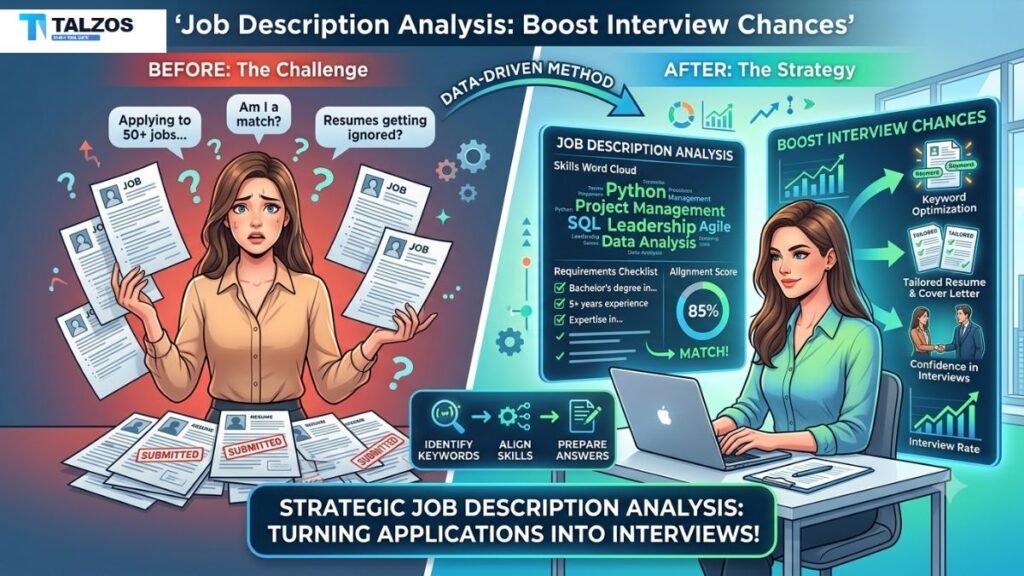
One of the biggest reasons candidates miss interview opportunities is simple: their resume does not match the language of the posting. Job description analysis shows you which skills, tools, and achievements to highlight so your resume feels built for that role.
When your resume mirrors the role’s core requirements, it becomes easier for a recruiter to see the fit quickly. That alignment can improve your chances of getting called in for an interview because it reduces the effort needed to connect your background to the job.
2. It helps you predict interview questions
Most job descriptions contain interview clues in plain sight. If the posting says “manage projects,” “improve processes,” or “partner with stakeholders,” those verbs often translate into behavioral interview questions about leadership, problem-solving, and collaboration.
By turning each responsibility into a possible question, you can prepare stronger answers before the interview starts. That means fewer rambling responses and more focused stories that prove you can do the job.
3. It helps you answer with better examples
Interviewers respond well to examples that are specific, relevant, and outcome-driven. Job description analysis helps you choose stories from your experience that match what the employer is asking for, instead of relying on generic achievements.
This makes your answers feel more credible and more memorable. Rather than saying you are “great at teamwork,” you can describe a time you worked with a cross-functional group to solve a problem the posting clearly values.
4. It helps you sound genuinely interested
Hiring managers can tell when a candidate has actually studied the role. When you reference the exact responsibilities, challenges, or priorities from the job description, you show that you are not just applying everywhere blindly.
That kind of preparation signals respect for the opportunity and makes your interest feel real. It also helps you speak the hiring manager’s language, which can make the conversation feel smoother and more natural.
5. It helps you spot gaps early
Not every job description will perfectly match your background, and that is okay. The value of job description analysis is that it shows you the gaps early, so you can prepare honest and thoughtful responses instead of being caught off guard.
You may realize you need to strengthen a technical skill, prepare a transferable example, or explain a career transition more clearly. That preparation can make the difference between a shaky interview and a confident one.
How to Analyze a Job Description
Read it twice
The first read should give you the big picture. The second read should focus on the details: repeated words, required skills, ownership verbs, and any phrases that appear more than once.
This two-pass approach helps you avoid getting distracted by long company blurbs or broad statements. It pushes your attention toward the parts that actually affect interview performance.
Highlight the core requirements
Look for the responsibilities that seem essential to the role. These are usually the tasks the company expects the person in the seat to handle regularly, not the bonus skills that sound impressive but are not critical.
A simple way to do this is to group the posting into three buckets: required skills, preferred skills, and cultural clues. That structure makes it easier to build a prep plan that is clear and realistic.
Match each requirement to a story
For every core requirement, choose one strong example from your own experience. Your example should show what you did, how you did it, and what happened as a result.
This is where job description analysis becomes powerful. It stops your interview prep from being random and turns it into a targeted match between what the employer wants and what you can prove.
Turn bullet points into questions
A job posting is often a hidden list of interview prompts. If the role mentions “improving processes,” ask yourself, “Tell me about a time you improved a process.” If it mentions “working with stakeholders,” prepare for “How do you manage cross-team relationships?”
This method gives you a practical way to prepare instead of guessing. It also reduces anxiety because you enter the interview with likely questions already mapped out.
What to Look For
Repeated keywords
If a keyword appears several times, it probably matters. Words like “lead,” “manage,” “analyze,” “build,” “own,” or “collaborate” often reveal the real expectations behind the role.
Repeated keywords also help you identify which experiences to foreground in both your resume and interview answers. If the role keeps emphasizing “customer impact,” your examples should show measurable outcomes for customers, not just internal success.
Required versus preferred skills
Many candidates make the mistake of treating every bullet point as equal. In reality, the required skills are the ones that can make or break your candidacy, while preferred skills are usually helpful but not essential.
Focusing on the required skills first keeps your preparation efficient. It also helps you explain your fit honestly if you do not check every single box.
Culture and values
Job descriptions often include subtle clues about the company’s style. Words like “fast-paced,” “self-starter,” “collaborative,” or “detail-oriented” can hint at the work environment and the kind of person the team wants.
If you can reflect those values naturally in your answers, you come across as a better fit. That does not mean pretending to be someone else; it means showing the side of your experience that matches the environment.
A Simple Example
Imagine a posting says the role needs someone who can “manage multiple projects, communicate with stakeholders, and improve workflow efficiency.” A candidate who only talks about general responsibility will sound vague.
A candidate who uses job description analysis will prepare stories about project coordination, client communication, and process improvement. That second candidate is more likely to give interview answers that feel specific, relevant, and convincing.
Common Mistakes to Avoid
Ignoring the hidden message
Some candidates focus only on the title and not on the details. But the real hiring priorities are usually buried in the responsibilities and repeated language.
Copying the posting too closely
You should mirror the employer’s language, but not parrot it blindly. Your answers still need to sound human, honest, and grounded in real experience.
Preparing only one generic answer
A single “tell me about yourself” script is not enough. Use the posting to prepare several role-specific stories so you can adapt naturally during the conversation.
Final Thoughts
Job description analysis improves interview chances because it helps you prepare with purpose. It sharpens your resume, predicts likely questions, and gives you better examples to use when the interview starts.
Most importantly, it helps you show up like someone who already understands the job. And that confidence, clarity, and relevance are exactly what many hiring managers are looking for.