Getting more interview calls is not just about having the right experience. It is also about presenting that experience in a way that matches what employers and applicant tracking systems are looking for. That is where resume matching becomes a major advantage.
Many strong candidates lose opportunities because their resumes are too generic, too hard to scan, or not aligned with the job description. A well-matched resume helps recruiters quickly see that you are relevant for the role. It also helps your application pass initial screening more smoothly.
In this article, you will learn how resume matching works, why it matters, and how to improve your resume so it leads to more interview requests.
What Resume Matching Means
Resume matching is the process of tailoring your resume so it reflects the skills, keywords, qualifications, and experience a specific employer wants. It does not mean copying the job post word for word. It means translating your background into language that matches the role.
A recruiter reviewing dozens or hundreds of applications usually spends only a few seconds on each resume. If your resume does not quickly show relevance, it may get passed over. Resume matching helps close that gap.
It is useful for both human readers and automated systems. Many companies use applicant tracking systems, or ATS, to filter resumes before they reach a hiring manager. If your resume is well matched, it has a better chance of being seen.
Why Resume Matching Improves Interview Calls
Resume matching increases interview calls because it makes your application easier to understand and easier to trust. Hiring teams want to see that you can do the job. When your resume mirrors the needs of the role, that connection becomes clearer.
It also improves your ranking in keyword-based screening. If a job post asks for project management, stakeholder communication, and data analysis, and your resume includes those exact terms in a meaningful way, you are more likely to get noticed.
Here are the biggest benefits:
- Your resume appears more relevant to the role.
- ATS software is more likely to recognize your qualifications.
- Recruiters can scan your resume faster.
- Your experience feels more targeted and intentional.
- You reduce the chance of being filtered out early.
How ATS Affects Resume Matching
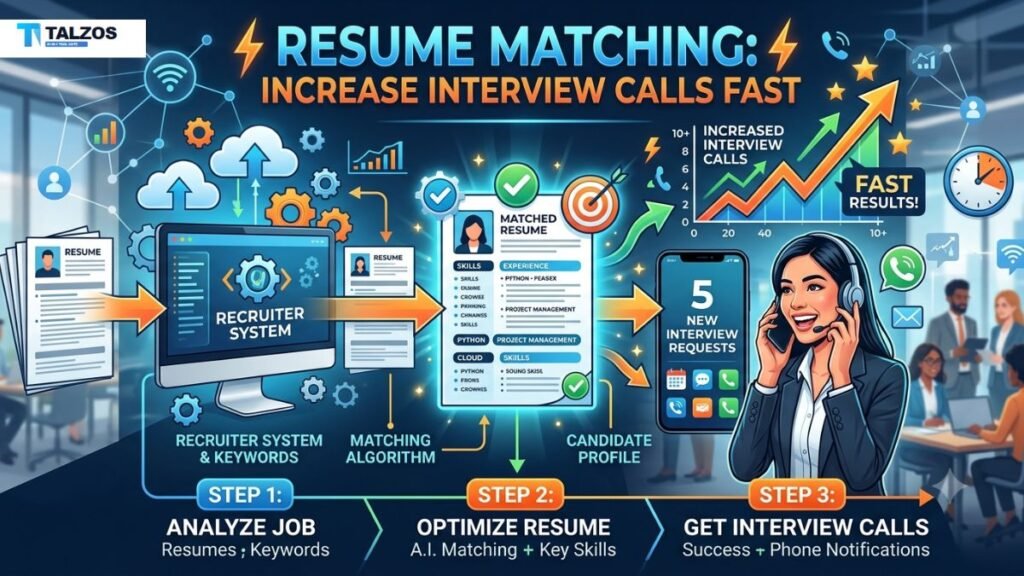
Applicant tracking systems are designed to sort and rank candidates. They scan resumes for keywords, job titles, skills, education, certifications, and sometimes formatting signals. That means a resume that looks great to a person may still underperform if it is not optimized for ATS.
This is why resume matching matters so much. ATS software is not looking for the most talented person. It is looking for the closest textual match to the job description. If the language on your resume does not align with the job post, the system may not recognize your fit.
To improve your chances, use standard section headings like Work Experience, Education, Skills, and Certifications. Avoid unusual graphics, text boxes, or formatting that can confuse parsing tools. Simple structure often performs better than flashy design.
How To Match Your Resume To A Job Description
The best resume matching starts with careful reading. Before you edit anything, study the job description and identify the most important patterns. Look for repeated skills, required tools, certifications, and responsibilities.
Then compare those details with your own experience. You are not inventing qualifications; you are making the most relevant parts of your background easier to find.
Use this process:
- Identify the top 8 to 12 keywords in the job description.
- Group them into skills, tools, responsibilities, and qualifications.
- Review your resume and find where those terms naturally fit.
- Rewrite bullet points to reflect the role’s priorities.
- Adjust your summary so it matches the target position.
For example, if a job description emphasizes “cross-functional collaboration,” your resume should not only say you worked with teams. It should show how you worked with product, sales, operations, or engineering teams to achieve a result.
Keywords That Matter Most
Not every keyword has the same value. Some words are simply nice to have, while others are essential. Resume matching works best when you focus on the language that appears most often in the job post and the qualifications that seem non-negotiable.
Pay attention to:
- Job titles and seniority level.
- Hard skills and technical tools.
- Certifications or licenses.
- Industry-specific terms.
- Soft skills that are repeated across the description.
- Action verbs tied to outcomes.
If the job asks for “Python,” do not substitute only “programming.” If it asks for “customer success,” do not replace it with “client support” unless both are used. The closer the language matches, the easier it is for both software and recruiters to recognize fit.
Better Bullet Points Make A Difference
Your bullet points should not just describe tasks. They should show relevance, scale, and results. Strong bullet points make resume matching more persuasive because they connect your experience directly to what the employer wants.
A weak bullet sounds like this:
- Responsible for managing team projects.
A stronger matched version sounds like this:
- Managed cross-functional projects for a 12-person team, improving delivery speed by 20%.
The second version includes action, context, and outcome. It also uses the kind of language hiring teams value. When possible, quantify your results with numbers, percentages, timelines, or scope.
Ask yourself:
- Did I use the same terminology as the job description?
- Did I show a measurable result?
- Did I make the skill easy to verify?
- Does this bullet prove I can do the job?
Match Skills Without Sounding Fake
One mistake job seekers make is stuffing keywords into the resume without real substance. That can make the document read awkwardly and reduce trust. Good resume matching should feel natural, not forced.
The goal is not to sound like the job post. The goal is to reflect your actual experience using the same professional language employers use. If you only have partial experience with a required skill, be honest but strategic. Show related experience and emphasize transferable strengths.
For example, if a role asks for stakeholder management and you have worked closely with clients, vendors, or internal teams, frame that experience clearly. You are matching meaning, not just words.
Tailor Your Resume Summary
Your summary is one of the first things recruiters see, so it should do real work. A generic summary can waste that space. A tailored summary can quickly signal that you are a strong match.
Instead of saying:
- Hardworking professional seeking opportunities for growth.
Say something more specific:
- Operations specialist with 6 years of experience in process improvement, team coordination, and data-driven reporting, seeking to support fast-paced logistics teams.
That version is more specific, more aligned, and easier to connect to a role. Use the summary to reflect your core value, primary skills, and target position. Think of it as your first matching signal.
Optimize The Skills Section
Your skills section should not be a random list. It should reinforce the job match in a quick, scannable format. Include the tools and capabilities most relevant to the position first.
If you are applying for marketing roles, for example, and the job mentions SEO, Google Analytics, content strategy, and campaign reporting, those should appear in your skills section if they are accurate. If you are applying for data roles, prioritize SQL, Tableau, Excel, dashboard reporting, and analysis tools.
Keep the section clean and relevant. Avoid listing outdated tools or generic traits like “hardworking” or “team player” in the skills area. Those are better shown in your bullets and summary.
Format Matters More Than People Think
Even strong content can fail if the resume is hard to read. Good formatting supports resume matching by making important information easy to scan. Recruiters should be able to find your current title, experience, skills, and achievements quickly.
Use a simple design with:
- Clear headings.
- Consistent fonts.
- Clean spacing.
- Standard section names.
- Bullet points instead of dense paragraphs.
Keep your resume ideally to one page if you are early in your career, or two pages if you have substantial experience. Most importantly, make sure the resume is easy to parse by ATS software and easy to read by humans.
Common Resume Matching Mistakes
Many candidates unintentionally weaken their resume match. These mistakes are easy to fix once you know what to look for.
Common issues include:
- Using one resume for every role.
- Ignoring the wording in the job description.
- Overloading the resume with buzzwords.
- Hiding key skills in long paragraphs.
- Using creative templates that break ATS parsing.
- Leaving out measurable results.
If your resume is not getting calls, the problem may not be your background. It may be how clearly your background is being presented. A few smart edits can make a big difference.
A Smarter Resume Matching Strategy
The strongest approach is to build a master resume and then tailor it for each application. Your master version should include all of your experience, achievements, skills, and certifications. Then you can quickly adapt it to each target role.
This saves time and improves quality. Instead of rewriting from scratch, you only adjust the most relevant parts. Over time, you will also notice patterns in the kinds of jobs you match best, which helps you apply more strategically.
A simple repeatable workflow looks like this:
- Save a full master resume.
- Choose one target role.
- Highlight job-specific keywords.
- Update summary, skills, and bullet points.
- Proofread for clarity and consistency.
- Submit only the version that best fits the role.
Final Thoughts
Resume matching is one of the most effective ways to increase interview calls because it helps your resume speak the language of the employer. When your resume clearly reflects the job description, it becomes easier for recruiters and ATS systems to see your fit.
The best resumes are not just accurate. They are targeted, readable, and intentional. If you want more interview opportunities, start by matching your resume to the role with precision and clarity. A better match often leads to better results.