If you want more interviews in 2026, your resume needs to do two jobs at once: impress a recruiter and pass the software that screens applicants first. The good news is that improving your ATS score is very doable when you know what the system looks for and how to use an ATS resume checker wisely.
What an ATS score means
An ATS, or Applicant Tracking System, is software employers use to collect, sort, and filter resumes before a human ever reads them. An ATS score is not a universal standard, but many resume tools estimate how closely your resume matches a job description based on keywords, formatting, section structure, and relevant experience.
That means a strong resume is not just “well written.” It is also easy for software to parse and clearly aligned with the role you want.
Why ATS matters in 2026
Hiring in 2026 is still heavily filtered by automation, especially for competitive roles and high-volume applications. If your resume is missing the right keywords or uses a layout the system cannot read, you may be screened out before a recruiter sees your value.
This is why an ATS resume checker is so useful. It helps you spot the exact issues that lower your match score so you can fix them before applying.
Start with the right job description
The fastest way to improve your ATS score is to tailor your resume to each job posting. Scan the description for repeated skills, tools, certifications, and role-specific phrases, then reflect them naturally in your resume where they truly fit.
Focus on:
- Core skills listed multiple times.
- Tools, platforms, and software the employer names.
- Job titles and seniority terms.
- Industry language used in the posting.
Do not stuff keywords randomly. The goal is to mirror the employer’s language in a way that still sounds human and accurate.
Use a clean ATS-friendly format
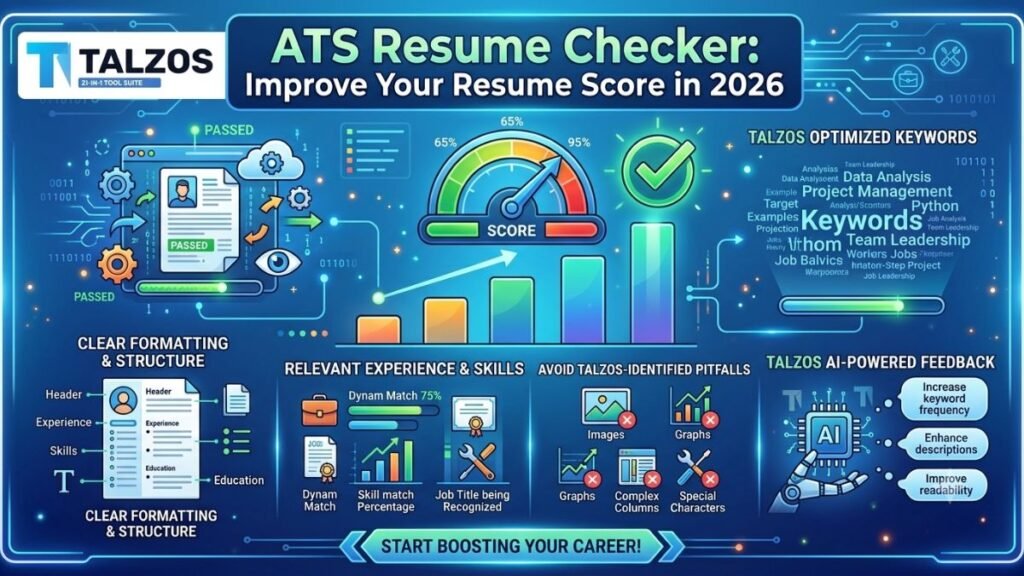
Even the best experience can lose ATS points if the layout is hard to parse. In 2026, the safest resume format is still simple: standard section headings, consistent fonts, clear chronology, and no design elements that confuse parsing tools.
Best practices include:
- Use a single-column layout.
- Keep section titles standard, such as Summary, Experience, Education, and Skills.
- Avoid text boxes, icons, graphics, tables, and heavy columns.
- Use common fonts like Arial, Calibri, or Times New Roman.
- Save as PDF only if the employer allows it; otherwise, follow the file type requested in the posting.
A clean resume is not boring. It is readable, reliable, and easier for both software and humans.
Match keywords naturally
Keywords are one of the biggest drivers of ATS matching. Most tools compare your resume against the job description and estimate how many important terms appear in the right context.
To improve this:
- Add exact keyword phrases from the posting when they fit your real experience.
- Use both full terms and common abbreviations, such as “Search Engine Optimization” and “SEO.”
- Include skill variants, such as “project management,” “project coordination,” and “cross-functional leadership” where relevant.
- Place important keywords in your summary, skills section, and work experience bullets.
The key is natural wording. If the resume sounds forced, it will hurt more than it helps.
Rewrite bullets for impact
Your bullet points should show results, not just responsibilities. ATS tools often reward relevant keywords, but recruiters reward proof. Strong bullets do both.
Use this formula:
Action verb + task + outcome + metric
Examples:
- Increased email conversion rate by 28% through A/B testing and audience segmentation.
- Managed a 12-person support team and improved response time by 35%.
- Built monthly reporting dashboards in Excel and Power BI for leadership decisions.
These lines are easy to scan and packed with meaningful context. They also make your achievements feel real instead of generic.
Build a stronger skills section
The skills section is a great place to reinforce keywords without sounding repetitive. Keep it honest, relevant, and focused on what the job actually needs.
A stronger skills section may include:
- Technical tools.
- Industry software.
- Core professional skills.
- Certifications and methods.
Avoid long keyword dumps. Group skills logically, and include only what you can defend in an interview.
Use an ATS resume checker wisely
An ATS resume checker can be one of the best tools in your job search if you use it as a guide, not a final judge. These tools analyze your resume against a job description and highlight issues such as missing keywords, formatting problems, and weak section alignment.
When reviewing results:
- Look for repeated keyword gaps.
- Check whether your job titles and section headings are clear.
- Compare the suggested match score with the actual quality of your resume.
- Make edits one at a time so you know what improves the score.
Some tools are better at keyword analysis, while others focus more on formatting feedback. The most useful habit is to test, refine, and retest until your resume reads well for both software and people.
Avoid common ATS mistakes
Many resumes lose score for avoidable reasons. These mistakes are easy to miss because they may look fine visually but break parsing behind the scenes.
Watch out for:
- Using headers and footers for important details.
- Saving the file with an unclear name like “resume_final_final.pdf.”
- Listing experience out of order.
- Including too many design elements.
- Using vague wording like “helped with” instead of specific action and outcomes.
A resume should be simple enough that the ATS can read it and strong enough that a recruiter wants to keep going.
Tailor your resume for every application
You do not need to rewrite your entire resume for every role. You do need to adjust it intelligently. Small, targeted changes often make a big difference in your ATS score.
Update these areas first:
- Summary statement.
- Top skills.
- Most relevant bullets.
- Tools, certifications, and industry terms.
This approach helps you stay efficient while making each application feel customized.
Keep it human, not robotic
It is easy to chase the score and forget the person reading the resume afterward. But the best resumes in 2026 still sound human, confident, and specific.
Write like this:
- “Led a product launch that increased retention by 14%.”
Not like this: - “Responsible for product launch support.”
Human language builds trust. Clear evidence builds interest. Together, they create a resume that works.
Final checklist before you apply
Before sending your resume, run through this quick check:
- Does the resume match the job description naturally?
- Are the section headings standard and easy to read?
- Did you include the most relevant keywords?
- Are your bullet points specific and measurable?
- Did you verify formatting with an ATS resume checker?
If the answer is yes, you are in much better shape than most applicants.
Conclusion
Improving your resume ATS score in 2026 is not about gaming the system. It is about making your experience clear, relevant, and readable for both software and people. With smart keyword targeting, clean formatting, strong bullet points, and an ATS resume checker, you can raise your chances of getting past the filter and into the interview stage.